
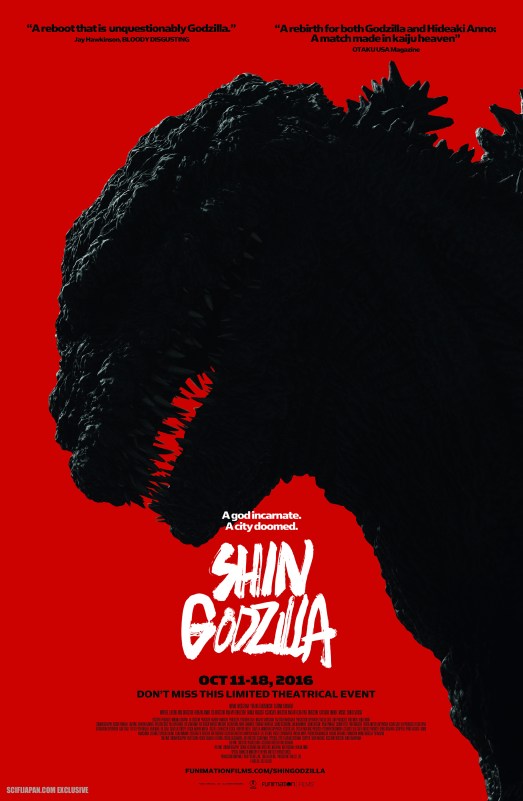
The first Godzilla film from Japan in 12 years… no way would I miss this!
What’s It About? A team of brilliant specialists race against time to stop a new, highly-evolved Godzilla before it destroys all of Tokyo.
STRAIGHT UP: Smart and sincere. A worthy reinvention of the franchise. 4/5
What I Liked
New-look Godzilla – I love the King of Monsters’ grotesque new look, and with his multi-directional atomic rays and the power of rapid evolution, he’s never been more dangerous. A dark new origin story adds an extra layer of malice, returning Godzilla to his original status as a horror icon.
So Anno – Director Hideaki Anno’s signature style is apparent in every second of this film. Scenes of rapid-fire dialogue in crowded spaces, high-angle close-ups of frustrated commanders, detailed attention to military hardware and logistics, and dramatic shots of kaiju glowing in the night sky should feel familiar to longtime fans. The movie even makes a few direct callbacks to Anno’s most popular work, Neon Genesis Evangelion – some of the music from that series is re-used here, and Godzilla’s abilities and movements resemble those of NGE‘s invading Angels.
Contemporary views – It’s not inaccurate to say that Shin Godzilla focuses more on the official response of government and military organizations to Godzilla rather than the destruction caused in the moment by the kaiju itself. In doing so, the screenplay reveals many of Anno’s up-to-the-minute thoughts about Japanese society – criticizing it for being overly cautious and bureaucratic, examining its political and military relationship with America, and speculating about the people best suited to become its next leaders. It’s pleasantly surprising to find such smart, relevant material in what’s typically regarded as a B-movie genre.
Subtle humor – The film can be playful with some of the commentary mentioned above. When the military halts a full-scale attack on Godzilla to avoid hitting an old man walking his dog, or as leading man Yaguchi gains more official titles each time he’s re-introduced, it’s hard not to laugh.
Production values – This is easily the best-looking Japanese sci-fi film I’ve ever seen. The combination of CGI and classic tokusatsu techniques results in near-Hollywood quality visuals.
What I Disliked
Glacial pace – The movie’s opening acts are definitely too slow-paced for their own good, with most of them spent in identical-looking boardrooms filled with strangers in suits speaking tersely about events unseen by the audience. The shock and terror of Godzilla’s initial appearance is offset by a sense of relief that action is finally happening. It’s easy to tell that this movie is meant for adults, because any children in the audience will be hopelessly bored or asleep after the first 30 minutes.
CLOSING THOUGHT: It’s interesting to think how much more I liked this movie than the Hollywood-produced one from two years ago, especially considering how similar they are at face value. Both films are slow-paced affairs that feature Godzilla very conservatively, instead placing the dramatic stakes on the shoulders of a young man with a personal mission to defeat the monster. The difference is in the broader context that the two films provide. Between action scenes, Godzilla (2014) can only try (and fail) to get the audience invested in its token Marine and his desire to protect his cookie-cutter family. Shin Godzilla, in its quiet moments, becomes a story about its protagonists’ hopes and fears for all of Japan, set in motion by Godzilla’s appearance; the overall conceit is much more resonant and meaningful. Also, while the clash between Godzilla and MUTO in the 2014 movie is great, it can’t match the desperate tension in the final act of Shin Godzilla, where Yaguchi’s task force faces world-altering consequences should they fail.
Shin Godzilla isn’t just great compared to other films in its own franchise, though – it’s excellent by any standard, and I encourage you to find a way to see it.
 RED COMET REVIEWS